Has the Gloss Finally Come Off Salesforce?
Twenty-five years of looking at other people's orgs
I started working in the Salesforce ecosystem around 2001, which means I have spent the better part of twenty-five years inside other people's orgs, building things on the platform and, inevitably, staring at an enormous amount of Apex. I have seen some genuinely brilliant implementations, some spectacularly bad ones, and a fair few where Salesforce was being asked to do something it was never designed to do and was doing it anyway. I have also watched it turn businesses around, because for a long stretch it was simply a bloody good product.
Which is why this week's news that Microsoft is going after Salesforce and ERP customers with an AI-powered converter caught my attention. On the surface it is not remarkable. Microsoft and Salesforce have competed for two decades and nobody needs a blog post about that. What is remarkable is the target. I do not remember Microsoft going directly after the installed base before, and there are good reasons why it never did.
Microsoft was not even in this race when Salesforce started
It is tempting to tell this story as Salesforce being the antidote to Microsoft Dynamics, and I very nearly wrote it that way. It is not true, and the real version is more interesting. When I started, Microsoft did not have a CRM product at all. It was still buying its way into business applications.
| When | What actually happened |
|---|---|
| 1999 | Salesforce founded, selling CRM as a subscription against on-premise incumbents |
| April 2001 | Microsoft completes its acquisition of Great Plains for roughly 1.1 billion US dollars in stock |
| July 2002 | Microsoft acquires Navision, and the two form Microsoft Business Solutions |
| January 2003 | Microsoft CRM 1.0 ships, branded Microsoft Business Solutions CRM |
| September 2005 | The Dynamics brand is introduced to pull the ERP and CRM lines together |
So for the first couple of years of my career in this ecosystem there was no Dynamics to be an antidote to. Salesforce's actual foil was Siebel and on-premise CRM generally, which is exactly who the early no-software marketing was aimed at. Microsoft did not ship a CRM until 2003 and did not put the Dynamics name on anything until 2005.
The part of my original instinct that survives contact with the dates is the hardware. Some of the mid-2000s Dynamics implementations I walked into required an infrastructure investment that would have consumed the entire IT budget of a mid-sized organisation before anybody logged in. Salesforce needed a browser. That contrast was real, it just arrived a few years later than I remembered it.
And once it existed, Microsoft seemed content to leave Salesforce broadly alone. Salesforce had found its market, Microsoft had Office, Windows, Server and eventually Azure to worry about, and CRM was not the hill either of them was going to die on.
Success has a habit of creating complexity
Then Salesforce did the thing that changes everything, which is that it became successful. Over the following twenty years it acquired companies and technologies and built an enormous platform around the original CRM. Marketing, commerce, analytics, integration, data, Slack, industry clouds, Flow, and now Agentforce.
I am not saying those products are bad. Several of them are very good indeed. But here is the uncomfortable bit for anyone who has been on the platform a long time. The customer who bought Salesforce fifteen or twenty years ago because they wanted a good, comparatively cheap, highly customisable CRM is now looking at a rather different proposition. Every new layer adds functionality, and every new layer adds cost, and a great many of those customers did not ask for most of it. They want CRM. They want their salespeople using it, their data where they can get at it, their customisations intact and their integrations working. They did not put Slack, Data 360, Agentforce and next year's strategic acquisition on the requirements list.
Nobody wakes up wanting more software. They want the business to work.
The moat was never the product
Once you have been in the ecosystem for ten or fifteen years, leaving is not a weekend project, and that has always been Salesforce's real defence. I have seen orgs with years of Apex, Flows, custom objects, integrations, permission models, reports and business logic woven so far through them that no single person in the building could describe the whole thing.
The question was never whether Dynamics could replace Salesforce. Of course it could. The question was always the expensive one:
What have we actually built here, and how much of it do we have to rebuild?
Answering that properly has historically meant a discovery engagement, a small army of consultants and a number of months, and the answer arrives as a slide deck that is out of date before it is presented. The cost of finding out was itself a large part of the reason nobody found out. That is a remarkably effective moat, and it is worth being clear that Salesforce did not build it deliberately. It is what happens when a platform is genuinely extensible and customers genuinely extend it.
What Microsoft has actually shipped
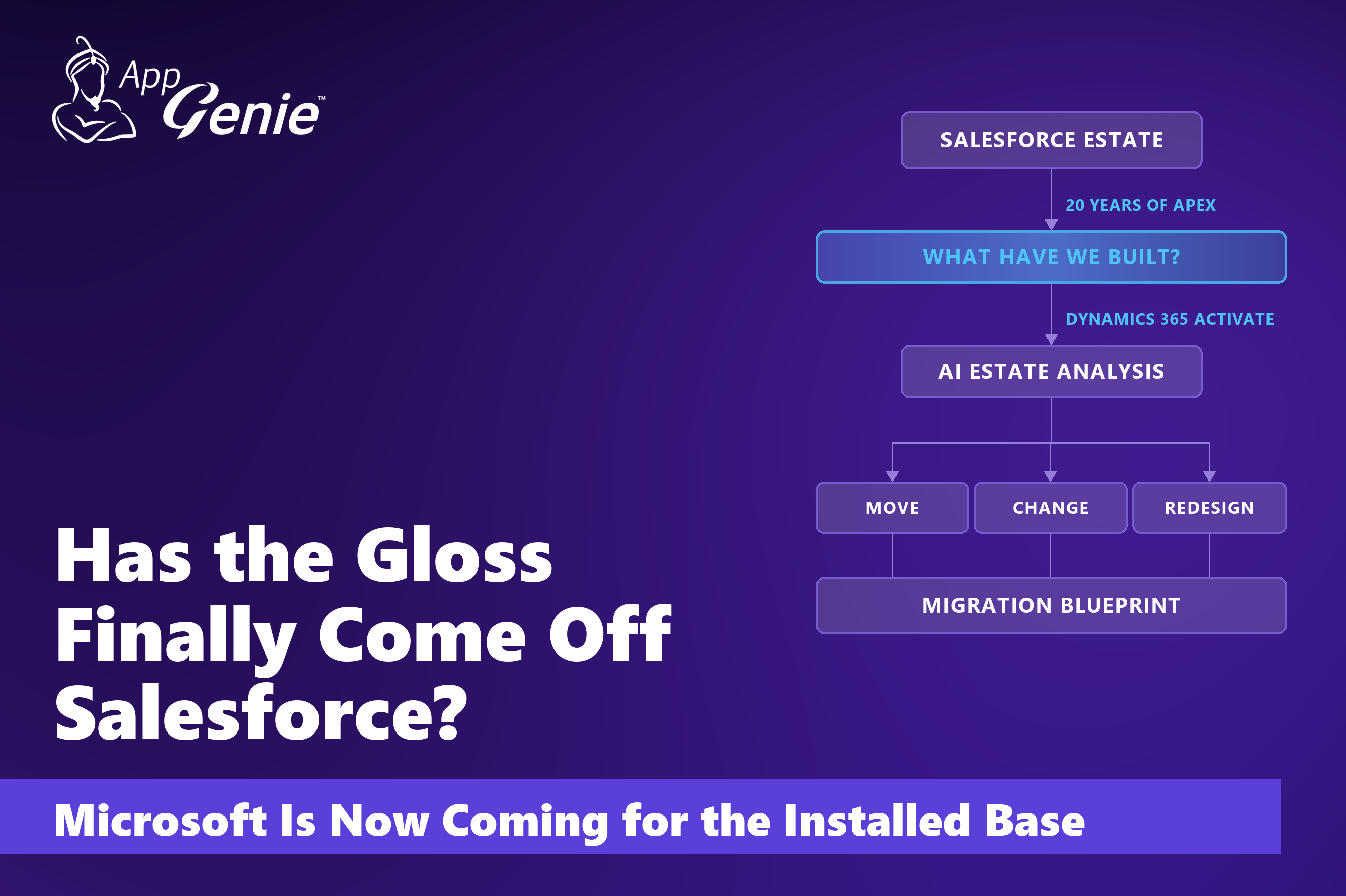
Microsoft's answer is called Dynamics 365 Activate, and it is aimed squarely at that question. It analyses an existing environment, its data, business processes, customisations and dependencies, identifies the relationships between them, surfaces the customisations that need attention, and produces what Microsoft describes as a clearer blueprint for what should move, what should change and what should be redesigned before a migration begins. Jeff Teper, Microsoft's EVP for Apps and Agents, framed it as helping partners and customers move to Dynamics 365 faster, with less manual effort and lower migration risk.
Read the positioning rather than the feature list. Microsoft is not saying its CRM is cheaper. Microsoft is saying: give us your Salesforce estate and we will work out how to get you out of it. That is a broadside, and it is aimed at the one thing that has reliably kept customers in place.
Odoo is attacking the same problem from the other end
Microsoft is not the only pressure on this model. Odoo comes at it from completely the other direction. Rather than bolting specialised products onto a CRM and charging separately for each layer, it offers a broad suite of business applications on a simple commercial proposition: one platform, one subscription priced per user, and the price is the same whether you switch on three applications or seventy.
Whether that suits a large enterprise is a separate argument, and often the answer is no. But it is a direct attack on the per-layer licensing model, and it is growing because a lot of organisations have quietly worked out that they were buying software to solve a problem created by their last software purchase.
The irony is that Salesforce taught the industry how to do all of this. Cloud delivery, APIs, configuration over code, extensibility, rapid deployment, software an actual user could get their head around. The industry copied the good bits years ago. What it is now copying is the commercial lesson, which is that more functionality does not have to mean another licence.
So has the gloss come off?
No. Not on the numbers, and it is worth being precise about them rather than gesturing at a narrative.
That is a strong quarter by any reasonable reading, and the AI and data story behind it is credible rather than decorative. Two footnotes in the same release are worth reading, though, because they are the sort of detail that gets lost between the press release and the headline.
The first is what sits inside the growth. The 200 million dollar guidance raise breaks down as 100 million of organic growth, 200 million from the pending Contentful and Fin acquisitions, and a 100 million dollar currency headwind. So the raise is mostly acquired, and the reported revenue growth includes Informatica. The second is that, effective this quarter, the Agentforce ARR figure now includes Salesforce's AI offerings, Slackbot and Headless 360. Salesforce discloses that plainly, to its credit, but it does mean the 240 per cent is not measuring quite the same thing it measured last quarter.
None of that makes the results weak. It makes them the results of an incumbent: growing steadily, buying growth where organic growth is harder, and reorganising how the flagship metric is defined. Which is rather the point of this whole post. Salesforce has not lost its shine. It has stopped being the scrappy outsider telling Microsoft and Oracle that the old way of doing enterprise software was broken, and become the thing that a new generation of scrappy outsiders is now saying that about.
Why this fight is different
Back in 2001, Salesforce was the company coming after Microsoft. Twenty-five years later, Microsoft has decided the Salesforce installed base is worth hunting, and it is not chasing the next Salesforce customer. It is chasing the ones Salesforce already has.
That is a materially different contest. Winning new logos is a sales problem. Prising out an entrenched estate is an engineering problem, and it has always been an engineering problem too expensive to take on. If AI genuinely makes the cost of answering "what have we built here" drop by an order of magnitude, then the moat gets shallower, and it gets shallower for every large platform at once. That cuts in more than one direction, incidentally. The same capability that makes it cheaper to leave Salesforce makes it cheaper to leave Dynamics.
What to take from this
- Know what you have built before somebody else offers to tell you. If a vendor's migration tool is the first complete picture of your own estate, you have a governance problem, not a licensing one.
- Separate the CRM you need from the platform you have accumulated. Most organisations have never actually costed the layers they do not use.
- Treat an estate analysis as a hypothesis, not a plan. It is generated output about your most complicated system, and it needs verifying by someone who will still be there when it goes wrong.
- Read the footnotes in the earnings release. Acquired revenue and redefined metrics are not scandals, but they are not organic growth either.
- Do not confuse switching platforms with fixing anything. An estate nobody understands will reconstitute itself on the new platform within about three years.
I have been watching Salesforce for nearly twenty-five years and I am not predicting its decline, which would be a very silly thing to do about a company growing at eleven per cent with 33.5 billion dollars of contracted future revenue on the books. But the terms of the argument have shifted. For most of that time the strongest reason to stay was that leaving was unthinkable, and that reason was never really about the product. If that changes, every platform vendor whose retention depends on accumulated complexity has a new problem, and the ones who noticed early will be the ones making the case on the product instead.
This one is going to be interesting.